
Computer-Assisted Language Learning
Japan Association for Language Teaching
JALTCALL is part of the Japan Association for Language Teaching (JALT). We hold a major annual CALL conference in Japan (usually in June), plus workshops and forums at various other times through the year. We also publish referred research articles through our Scopus Q1 ranked publication JALT CALL Journal, as well as work-in-progress research and a wider variety of articles in our new publication, JALT CALL Trends. Membership in JALT or JALTCALL is not required for attending our events or submitting to our publications, however we encourage interested participants to consider membership. You may wish to join our Facebook Group.
JALTCALL 2027

Latest Newsletter
March 2026 newsletter
JALTCALL PODCAST
September 2026 Studio Talk Kumamoto Quake w Luc Robert and Brian #42
In this episode, host Brian Gallagher talks with Luc Gougeon and Robert Remmerswaal as they share their personal experiences during and after the seismic events that shook Kumamoto in July of this year.
On July 26, a significant earthquake rocked Kumamoto, registering a magnitude of 7. While Luc’s home emerged unscathed, just a hundred metres away, neighbours faced extensive damage to their kitchens.
Robert shared how fortunate he was to have left work just before the earthquake struck. He reflected on the potential disaster he narrowly avoided: “If I was lucky, I would have stood up and moved towards the door… I would have been knocked unconscious by my bookshelf.” Luc and Robert describe the eerie quiet that followed the earthquake, punctuated by frequent aftershocks that lasted for two weeks. Luc mentions the unusual sight at a local Costco, where a crater had formed in the parking lot, a stark reminder of the earthquake’s force. The conversation turns to the devastating explosion at the AEON Mall, which occurred shortly after the earthquake. The resilience of the Kumamoto community shines through these stories of survival and recovery. As they navigate the aftermath of these disasters, their shared experiences remind us of the importance of preparedness and community support.
We also discuss the conference events of the year so far and coming up, as well as recent research on AI use in Chinese high schools and their effects on student learning.
Enjoy the show.
JALTCALL Teacher Development Spring Symposium
JALTCALL Spring Symposium (2026 Edition)
Date: March 7, 2026 (Saturday)
Time: 12:30 – 17:00 (tentatively – see note below)
Venue:Kyoritsu Women’s University, Tokyo
Participation: ¥1,000 (¥500 for JALT members)
Registration: https://forms.gle/RXpaRkTbTLZpZ3cw6

Registration: https://forms.gle/RXpaRkTbTLZpZ3cw6
Event: JALTCALL Spring Symposium 2026 – Teacher Development
Date: March 7, 2026
Time: 12:30 – 17:00
Venue: Kyoritsu Women’s University (Building 2 – Jimbocho Station Exit A8)
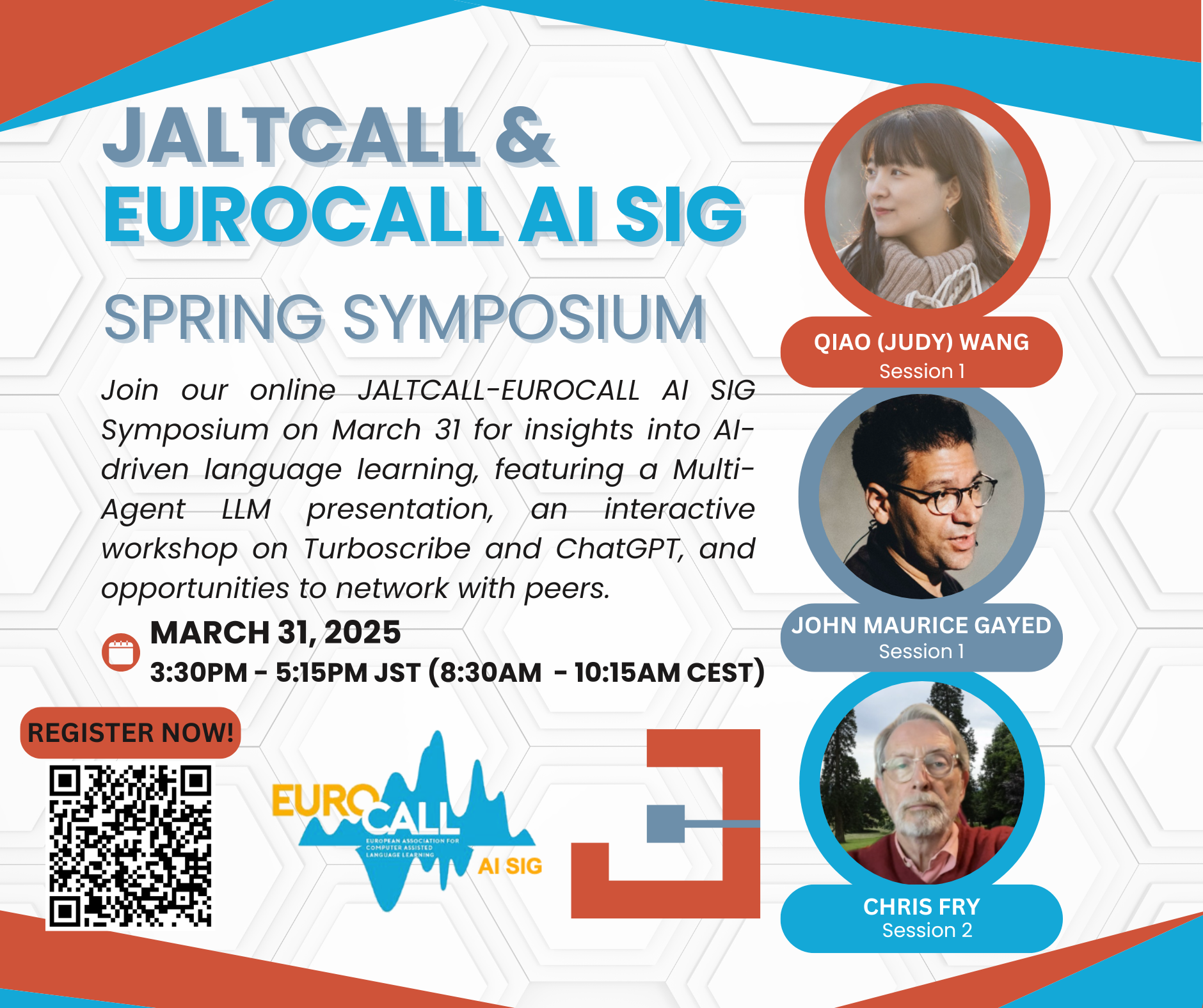
After the resounding success of our 2025 Spring Symposium (in collaboration with the EUROCALL AI SIG), JALTCALL is pleased to announce the 2026 iteration of this event. This year’s spring symposium, focusing on Teacher Development, will be held face-to-face on March 7, 2026, at Kyoritsu Women’s University in central Tokyo.
For this symposium, we want to do something a little different. While the JALTCALL Conference continues to showcase high-quality research, this event places skills development at the forefront. The focus will be on hands-on, interactive workshops, guided discussions, and collaborative sessions designed to help teachers build skills they can immediately use in their classrooms.
Participants should be ready to roll up their sleeves, dust off their teaching and technology skills, and actively take part. Be sure to bring your own devices! Sessions will emphasize practice, experimentation, and shared problem-solving in areas related to CALL, technology-enhanced language learning, and classroom innovation.
The symposium is being planned in collaboration with multiple JALT SIGs and chapters (more details soon), and is open to teachers at any career stage and with any level of technical experience. Whether you are confident with educational technology or just starting out, this event is designed to be welcoming, supportive, and practical.
To encourage conversation and connection, the event will also have a networking-focused atmosphere, with refreshments and snacks provided. We are currently planning an afternoon programme (tentatively 12:30–16:30), with the possibility to expand depending on interest. Participants are welcome to bring food and gather informally beforehand.
Speaker Info:
Satchie Haga, PhD
Hacking the local context: A facilitated dialogue on how to develop more culturally relevant technology-supported lessons
This interactive session examines how digital tools can be used to support our students’ context and lived experience. Participants will engage in a guided dialogue to identify cultural bias in common software used in education such as interactive and collaborative platforms, AI, online gamification, and course management systems. Also, we will examine our integration of these tools and share successful methods for adapting them or our pedagogy specifically for the Japanese EFL context.
Mariana Oana Senda
Low-Tech CALL, High-Impact Speaking: Activating the Social Brain through Small-Group Video Projects
Teachers experience and build a 3–4 lesson pair video project (Plan → Rehearse → Film → Caption → Reflect/Transfer) designed for Japanese EFL contexts. The workshop emphasizes peer interaction design to reduce anxiety, increase output, and support durable language reuse. Participants leave with editable templates (storyboard, scripts, language banks, role cards, feedback + reflection sheets) and an idea of implementation plan.
Bio: Mariana Oana Senda is Tokyo-based and currently doing a PhD in Applied Linguistics (TESOL) through neuroscience/neuroeducation perspectives, alongside 20 years of classroom experience across levels.
Heather Woodward
From Passenger to Pilot: Teaching Self-Directed and Reflective Language Learning through Metacognitive Stations
Autonomy is not a personality trait. It is a skill set. Like any skill set, it improves when we stop telling learners to “be reflective” and instead design environments that make reflection unavoidable. This highly interactive, tech-forward workshop introduces a station-based approach. Participants will rotate through seven activity stations, each representing a core component of the metacognitive process. Working with a partner, participants will complete short, guided activities by scanning QR codes and engaging with mobile-based tasks designed to externalize thinking and prompt structured reflection. By experiencing the activities from an EFL learner’s perspective, participants will gain practical insight into how metacognition can be explicitly taught.
Bio: Heather has taught in China, Vietnam, and Japan before joining Rikkyo University in 2019. She is the Tokyo Chapter President of JALT and has earned her M.S. Ed in TESOL from Temple University. Currently, she is pursuing her doctorate in Educational Technology at the University of Florida.
Bradley Irwin
Student-Ready Materials in Minutes: A Practical Workshop for Leveraging NotebookLM for Self-Study
NotebookLM is a source-grounded “thinking partner” that helps teachers and students generate learning supports directly from uploaded course materials (PDFs, slides, readings, and web sources). In this hands-on workshop, participants will learn an end-to-end workflow for creating student self-study packs, including building a curated source set, asking effective questions with citations, and utilizing NotebookLM Studio to produce reusable outputs such as study guides, quizzes/flashcards, mind maps, and audio/video overviews. Participants will leave with a ready-to-use self-study template, classroom-friendly prompts for preview/review/exam preparation, and practical strategies for keeping outputs accurate and aligned with course objectives.
Bio: Bradley is a tenured Associate Professor in the Department of Arts and Letters at Kyoritsu Women’s University and a PhD student at Waseda University. He holds an M.Ed. from OISE, University of Toronto. His research interests include innovative approaches to feedback, learner autonomy, and technology-enhanced language learning (CALL and MALL).
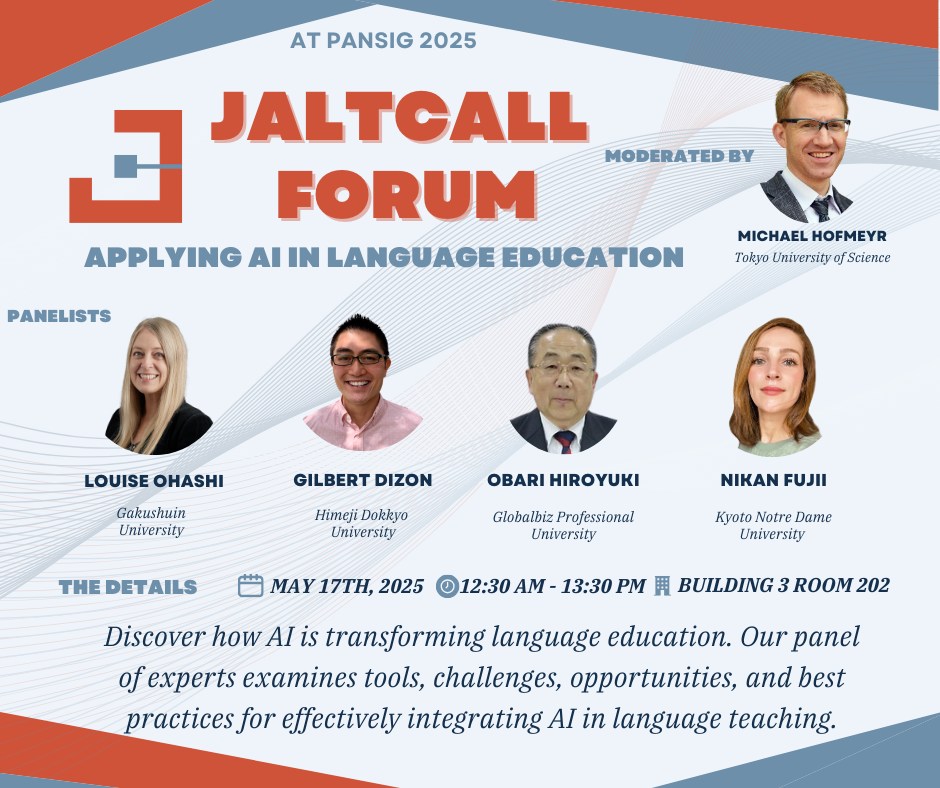
JALTCALL Forum at PANSIG 2025
JALTCALL & EUROCALL AI SIG
JALTCALL 2024 Recap
The JALTCALL 2024 conference in Nagoya was a great success. Thank you to all of the speakers, attendees, volunteers, and to our great conference team! Photos | Posters | Abstracts